Vector-agnostic
Validated for AAV and applicable to lentiviral vector production.
The science
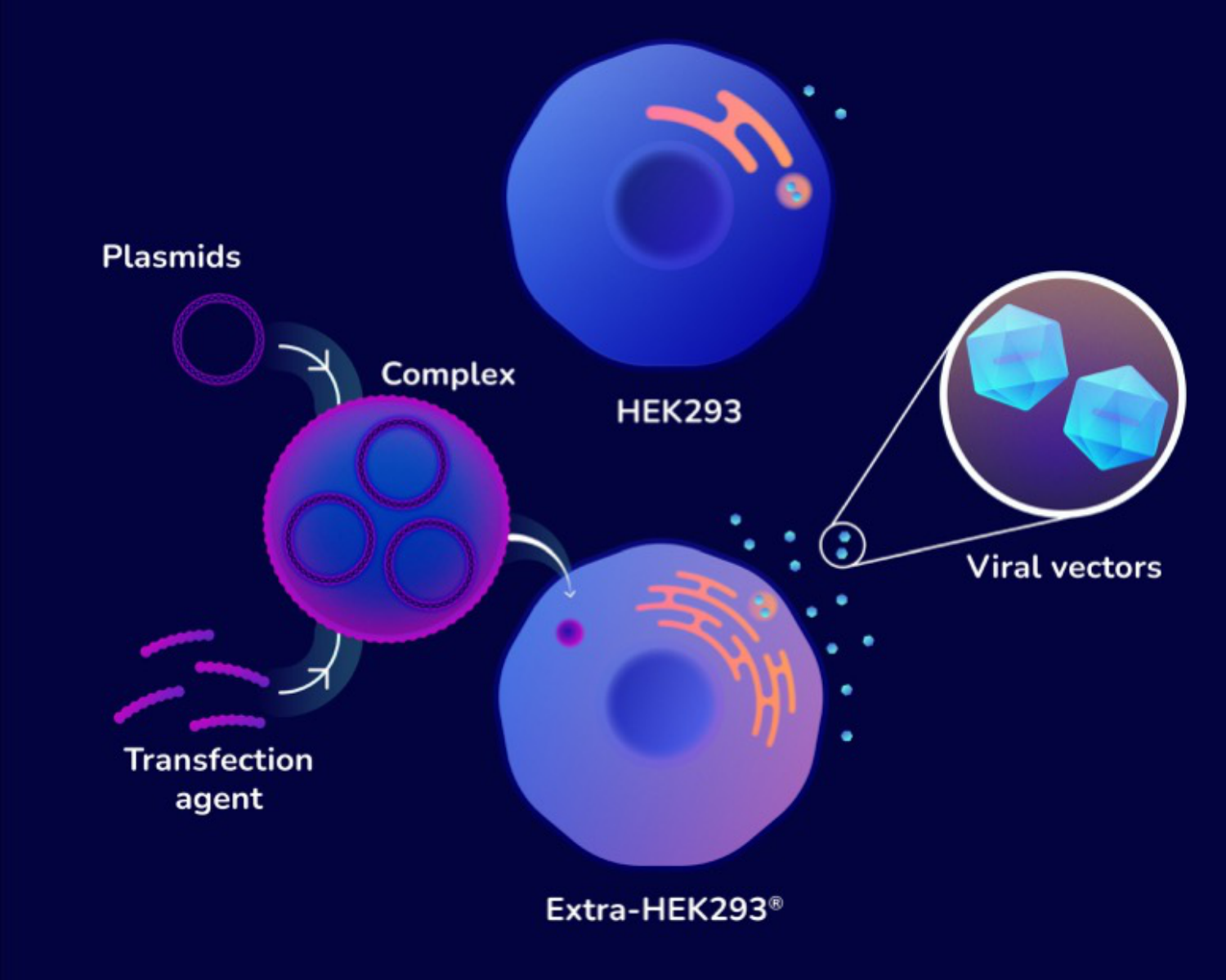
Most efforts to raise viral vector titer focus on the process: media, feeds, transfection conditions. ExtraCell works one level deeper: we re-programme the producer cell itself, so it devotes more of its machinery to building virus.
The bottleneck
Cell lines such as HEK293 are workhorses for manufacturing AAV and lentiviral vectors, but they were never evolved for the job. A large share of their biosynthetic and secretory capacity is spent on genes and pathways that don't contribute to, and can actively limit, vector production.
The result is low, variable production yield: more batches, bigger facilities, and a cost per dose that can reach millions in gene therapy.
The mechanism
Guided by our understanding of the secretory cell machinery, ExtraCell identifies genes whose controlled down-regulation re-balances the cell toward high-yield vector output. Our lead target, EXT1, is one such gene.
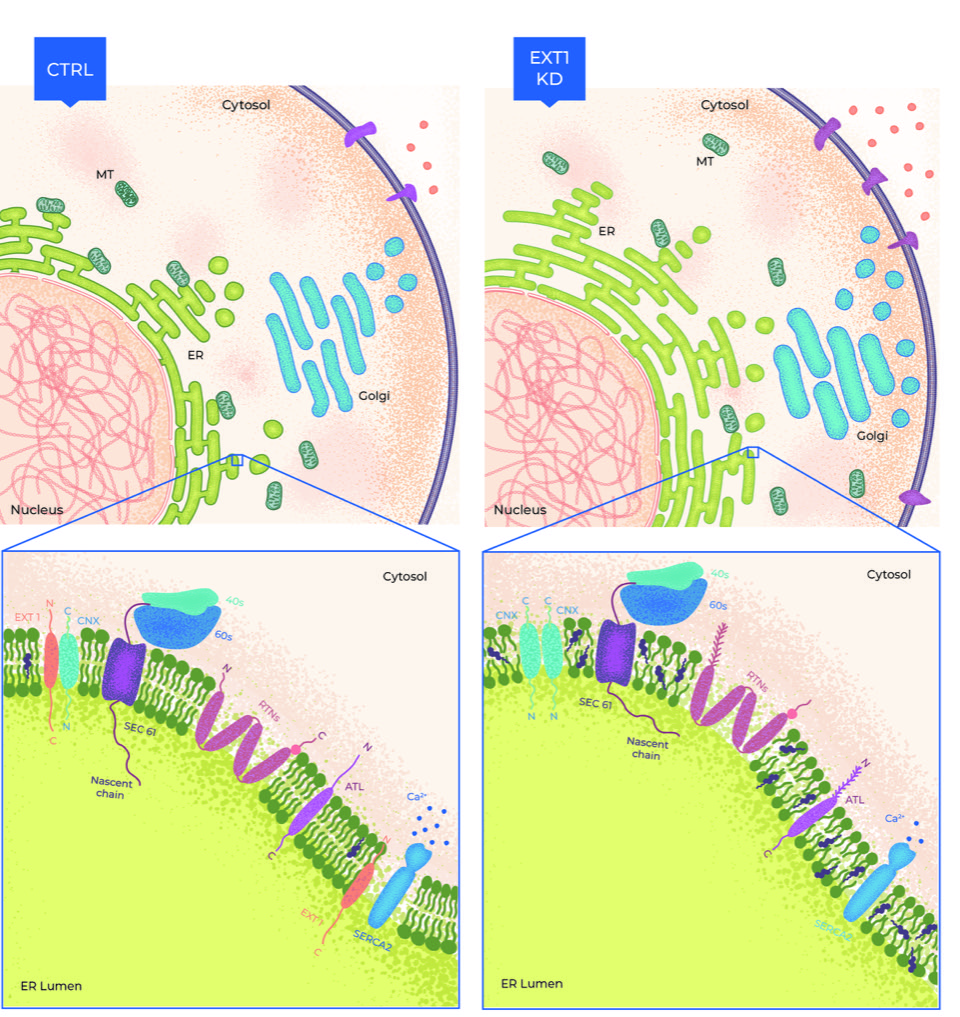
Knocking down EXT1 reshapes the early secretory pathway (the endoplasmic reticulum (ER) and Golgi) and the organisation of protein complexes at the ER membrane, expanding the cell's capacity to fold, traffic and release recombinant product. Crucially, it's not only which gene, but the precise level of regulation that matters.
Our lead down-regulation target: the trigger for the remodelling.
The translocon channel that threads nascent chains into the ER.
Calnexin: folding and quality control of new proteins.
Reticulons and atlastin that shape ER tubules and membrane dynamics.
Calcium pump maintaining the ER environment for secretion.
ExtraCell's cell-engineering approach is protected by an international patent, validated on experimental AAV production data: a defensible foundation covering mammalian producer cells.
What it delivers
In head-to-head triple-plasmid AAV2 production, engineered cells out-produce the parental line, translating into fewer batches, smaller footprints and, in gene therapy, roughly half the manufacturing cost per patient.
Validated for AAV and applicable to lentiviral vector production.
Same transfection and upstream process: the gains come from the cell.
Extra-CHO, Extra-MDCK, Extra-Vero and Extra-iPSC lines in development.